When Christianity Looks Like Scrooge
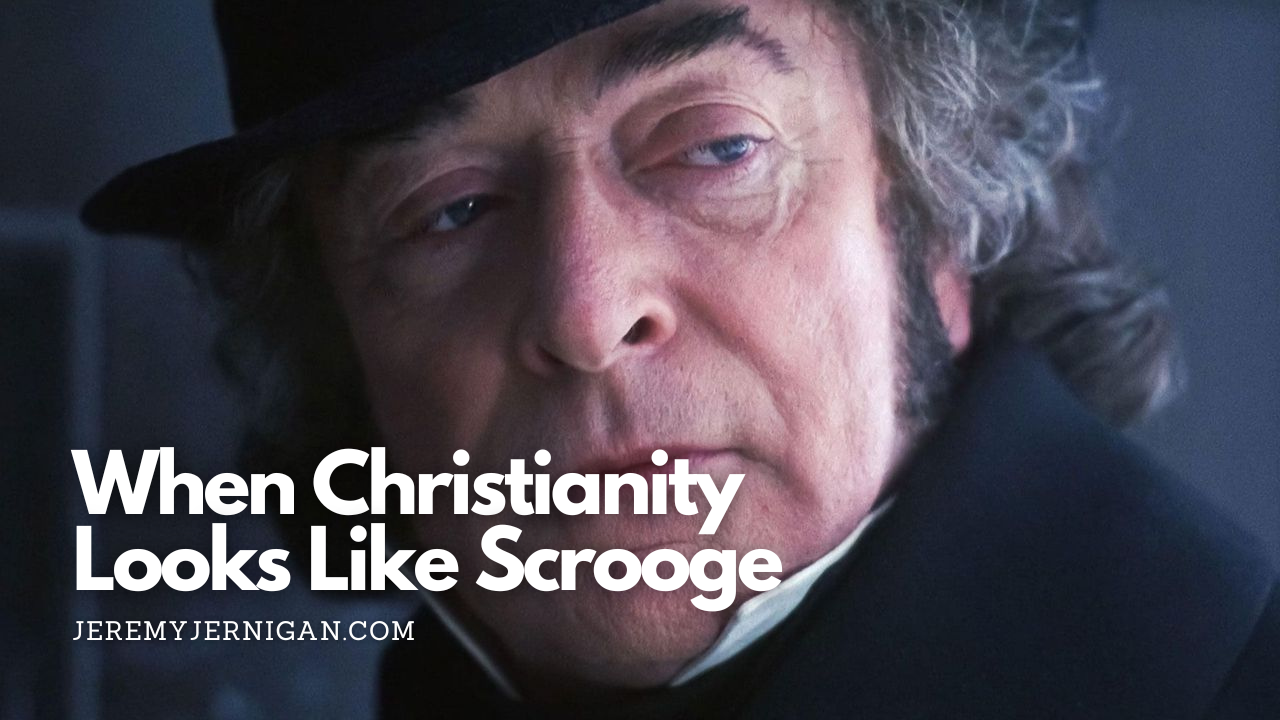
My favorite Christmas story is A Christmas Carol by Charles Dickens. I read the book every December, and we watch The Muppet Christmas Carol every Christmas Eve (which is obviously the best film depiction by far).
It's easy to think that A Christmas Carol is a story about greed and about how rich people should give more money to the rest of us. But there's a deeper message throughout the story that we would do well to learn from today.
In talking with his nephew, Scrooge explains why he hates Christmas.
Out upon merry Christmas! What’s Christmas time to you but a time for paying bills without money; a time for finding yourself a year older, but not an hour richer; a time for balancing your books and having every item in ’em through a round dozen of months presented dead against you? If I could work my will,” said Scrooge indignantly, “every idiot who goes about with ‘Merry Christmas’ on his lips, should be boiled with his own pudding, and buried with a stake of holly through his heart. He should!”
According to Scrooge, celebrating at Christmas is a logical absurdity. Why on earth would you choose to celebrate when the "proper" conditions aren't met? A few moments later, in a conversation with a couple of gentlemen asking for donations for the poor, Scrooge says, "I don’t make merry myself at Christmas, and I can’t afford to make idle people merry."
Notice the logic displayed in these passages. Scrooge believes Christmas to be a waste and then expects everyone else to live by his way of thinking.
One might assume that, according to this logic, Scrooge thinks rich people like him are the only ones who could appropriately celebrate Christmas. After all, he has the money to pay his bills and to balance his books. But he obviously doesn't celebrate Christmas. That's because Scrooge's actual argument isn't even about Christmas. Scrooge's real driving passion is his expectation that others should live by the rules he decided for himself. This isn't a story primarily about generosity; it's a story about control.
One might be willing to entertain Scrooge's way of life as a possible option, except for the fact that Dickens powerfully shows what often accompanies greed. Ironically, in the pursuit of acquiring more for oneself, greed also harms the user.
Examples of this abound throughout the novel.
- Scrooge doesn't enjoy warmth as he works in his office: "His nephew left the room without an angry word, notwithstanding. He stopped at the outer door to bestow the greetings of the season on the clerk, who, cold as he was, was warmer than Scrooge..."
- And later, when Scrooge is at home: "It was a very low fire indeed; nothing on such a bitter night. He was obliged to sit close to it, and brood over it, before he could extract the least sensation of warmth from such a handful of fuel."
- Scrooge doesn't enjoy his meals: "Scrooge took his melancholy dinner in his usual melancholy tavern..."
-
Scrooge doesn't use adequate light to find his way: "Half-a-dozen gas-lamps out of the street wouldn’t have lighted the entry too well, so you may suppose that it was pretty dark with Scrooge’s dip. Up Scrooge went, not caring a button for that. Darkness is cheap, and Scrooge liked it."
Perhaps the best passage that illustrates this is from Scrooge's nephew.
“He’s a comical old fellow,” said Scrooge’s nephew, “that’s the truth: and not so pleasant as he might be. However, his offences carry their own punishment, and I have nothing to say against him.”
“I’m sure he is very rich, Fred,” hinted Scrooge’s niece. “At least you always tell me so.”
“What of that, my dear!” said Scrooge’s nephew. “His wealth is of no use to him. He don’t do any good with it. He don’t make himself comfortable with it. He hasn’t the satisfaction of thinking—ha, ha, ha!—that he is ever going to benefit US with it.”
Scrooge has wealth... and yet it does no good to him or to others. As Dickens succinctly points out, the offence carries its own punishment. Nobody who reads the novel envies Scrooge or wants to be more like him. Who wants to live a life like that? Therefore, we should be wary of Scrooge's logic, which caused this lifestyle. After all, this is the way of life Scrooge expects from everyone else. Scrooge expects others to live by the rules he decided for himself.
Today, this same reasoning causes some Christians to wonder why others don't want to believe what they believe. It's likely because others have seen what kind of life those beliefs produce... and they're not interested. If I don't want to be more like you, why would I want to believe what you believe? If I don’t want your life, why would I want your faith?
A Christmas Carol is an example of how greed robs you and those around you of life. Even more, it's about not expecting others to live by our values, especially when we may be more misguided than we think. I'd suggest that a proper reading of the story would cause one not only to evaluate their own life but also to consider whether they are trying to force their life onto others. And to my fellow Christians, we (collectively) are not doing well with this right now.
The apostle Paul understood that our beliefs are not disconnected from the life we live. That's why he invited the church to "imitate me, just as I imitate Christ" (1 Corinthians 11:1). The assumption being that Paul was in fact imitating Christ, or else this invitation makes little sense. Today, it seems that the Christian appeal is often to "imitate me, just as I imitate all sorts of things around me."
But like our dear friend Scrooge, we can change our ways. It's never too late.
By the end of the book—once Scrooge has transformed—we see that he desires to reverse his greed and bless those around him. He has a freedom of spirit that no longer seeks to impose his values on others. And unlike his life previous life, these actions positively benefit him, too.
He went to church, and walked about the streets, and watched the people hurrying to and fro, and patted children on the head, and questioned beggars, and looked down into the kitchens of houses, and up to the windows, and found that everything could yield him pleasure. He had never dreamed that any walk—that anything—could give him so much happiness.
Sign up with your email and never miss a post!
We hate SPAM. We will never sell your information, for any reason.