Is the Church a Team or a Family?
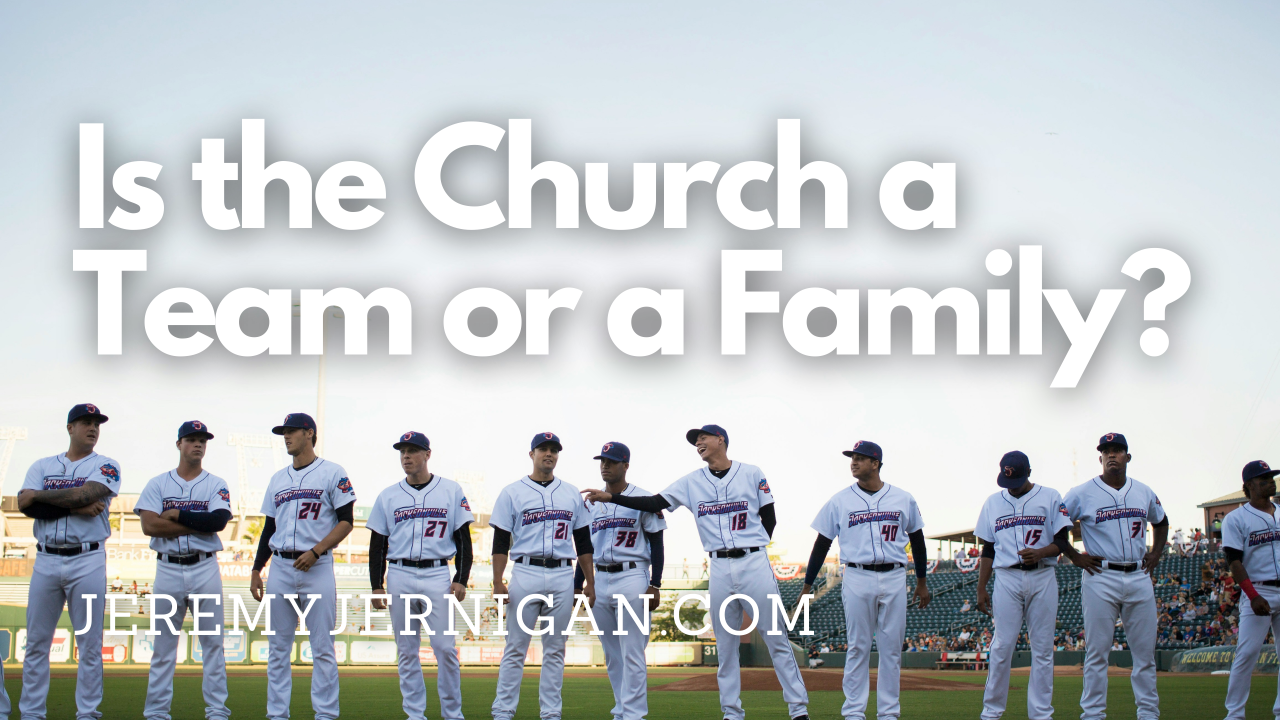
Is the Church more like a team, or a family?
If your church experiences have been similar to mine, you've likely heard far more talk of the church as a family. It implies something holistic, that we are together in a deeper sense. Especially when used in terms of salvation and inclusion, this image feels good.
But I recently had a church member offer me an illustration that I've been thinking about. He suggested that a church is more like a team than a family, and then gave me an interesting way of seeing it. If someone on a team gets injured, you sub them out and bring in another person to take their place. In baseball terms (as any good team analogy should naturally gravitate toward), if your first baseman suddenly rolls his ankle and can't stand up, you take him out of the game. But this doesn't mean you keep playing without a first baseman. It doesn't mean you stop the game either. Instead, you have another player step up to play that role. That's because the mission of what you're doing together is the focus.
Conversely, if someone in a family gets sick, you often change plans or cancel what you were going to do. If my family is planning a trip to the Grand Canyon, and the morning we are set to leave, we discover that one of us has the stomach flu, then we aren't going to the Grand Canyon. That's because family togetherness is the focus. That experience would be a bit bizarre if we left someone at home (or, even worse, replaced them with someone else).
While there is merit to both the family and the team metaphors for thinking about a church, I would suggest that in this season, we might need to lean more into the team metaphor.
Since much of our political conversations now use spiritual language, we can no longer assume we can maintain a clear line of separation. For some examples, Secretary of Defense Pete Hegseth recently said the following statements at an event:
- "As you know, there’s a direct through line from the Old and New Testament Christian gospels to the development of Western civilization and the United States of America."
- "Like few presidents before him, President Trump fights for Christians and the values they hold dear."
- "Gone is godless and divisive DEI, gone is gender-bending quotas, gone is climate change worship of a false god."
- "We are not in woke we trust, we are in God we trust."
- "The other side is fueled by godless and toxic ideologies, foreign to the Western way of life, with intolerant hearts filled with rage and hate."
- "Protecting our borders from criminals who steal from us, assault our loved ones and poison our citizens is not political, it’s biblical."
Because of this blending of political and spiritual rhetoric, churches have to decide which types of conversations to have. Some churches speak in support of Charlie Kirk, while some churches speak against the abuses of ICE (and many churches say the same things in quieter ways). And each church's mission depends on the conversations it decides to have.
This has caused many people who attend these churches to suddenly realize they may not resonate with the conversation their church community has chosen to have. That's when our analogy comes into play. If you think the church is a family, you will likely stick it out no matter what. Even if it makes you miserable, or if you realize you don't feel safe to fully be you in your community, or if you fear you are endorsing something you fundamentally think is wrong. But if you think the church is a team, you can decide you no longer want to support the mission of the church community you are part of, and go find one you do.
I've been noticing lately that the family image is leading people to work against their church's mission because they view participating in the community as the main goal (and this happens on both ends of the spectrum). This is likely leading to a growing number of people who are disgruntled, frustrated, or silently checked out of their church experience. But the church is not an avenue for community itself, as that can be found in a country club (see: The Parable of the Life-Saving Station). The church at its best is a community of people working together in the mission of embodying the hands and feet of Jesus in our world.
Perhaps it's time for us to lean more into the team image for the sake of the work to be done. From my vantage point, there is a staggering amount of work ahead of us as the animosity and dehumanization of people is increasing in ways not seen in our lifetimes.
We might wonder whether Jesus would be okay with us thinking of the church as a team rather than a family. In John chapter six, numerous disciples of Jesus decide to walk away from what He was doing and saying. It was too much for them. In reply, Jesus asked his twelve closest disciples, "Are you also going to leave?" (John 6:67).
Peter responds, "To whom would we go? You have the words that give eternal life" (John 6:68). Peter's reply isn't that they are a family and that leaving wouldn't make sense. Instead, Peter tells Jesus that no other mission would be worth giving their lives to. So they stay. Not because it was easy, but because they bought into the mission as part of the team.
And this is precisely what is needed in our moment. So take this as your invitation to find a church community (which can look like many different things) that resonates with you, and commit yourself to moving the mission forward.
Unlike the Grand Canyon, the people who need us right now can't wait.
Photo by Wade Austin Ellis on Unsplash
Sign up with your email and never miss a post!
We hate SPAM. We will never sell your information, for any reason.