The Trauma of Survival
My friend Andrew DeCort recently wrote an article in which he used the phrase "the trauma of survival." He was writing about the attacks on Iran and our country's obsession with power over others through violence. Here was the sentence in which the phrase jumped out to me:
The dear people of Iran will grieve their murdered loved ones and suffer the trauma of survival, just like the dear Palestinian people, along with Native people, Black people, queer people, the women of the world, and many "others."
After I read the article, I couldn't get the phrase out of my head. It captures the ache I feel whenever I study history and realize how horrific humanity has often been to one another, especially if you fall into one of the groups above. We would all desire a life of thriving, but for many, survival itself is challenge enough.
When we watch our loved ones fall deep under the spell of the rhetoric and propaganda, when we watch our regime dehumanize anyone who refuses to offer blind loyalty, when we watch our country continually be the aggressor around the world... how do we function in our day-to-day? It can feel like an absurd challenge just to keep your kids fed and to get everyone to their daily commitments. I've lost count of how many times I was deep in thought over something going on in the world, only to have one of my children interrupt me with something they needed in the moment. And we live with both of these realities each day.
Even if you're one of the ones who carries the weight, I suspect you also sense a nudge forward, an invitation calling us to take that next step ahead. C.E. Jarnagin wrote that "God is not behind us, urging shame, but ahead of us, whispering courage. To move 'always forward' is not to rush or strive, it is to keep participating in our becoming." It is that becoming, both in our own lives and that which we wish to see in the world, that allows for hope. And for the Christian, we can be hopeful even in the face of less-than-optimistic situations because moving forward is tied to our participation with Jesus, not in our efforts alone.
Evil has a large footprint but a short shelf-life. I'm reminded of how the great philosopher-king Marcus Aurelius spoke about pain. In Meditations, he observed how "unendurable pain brings its own end with it. Chronic pain is always endurable." The same can be said of the forces of evil. Unendurable evil brings its own end. But every other evil is always endurable.
We see this theme throughout the Scriptures, especially the Psalms. The seed of evil carries its own demise with it:
- Psalm 7:14-16 "The wicked conceive evil; they are pregnant with trouble and give birth to lies. They dig a deep pit to trap others, then fall into it themselves. The trouble they make for others backfires on them. The violence they plan falls on their own heads."
- Psalm 9:15-16 "The nations have fallen into the pit they dug for others. Their own feet have been caught in the trap they set. The Lord is known for his justice. The wicked are trapped by their own deeds."
- Psalm 10:2 "The wicked arrogantly hunt down the poor. Let them be caught in the evil they plan for others."
And on and on it goes. It's one of my favorite themes throughout the Psalms. Evil has a self-destruct mechanism built into it. History shows it too, although not usually as quickly as we'd want to see it. I wish it could happen much faster, as do all those who suffer under the effects of evil. But we've seen the fall of chattel slavery in the United States, Apartheid in South Africa, Soviet totalitarianism, Jim Crow, etc. All of these ended through a combination of internal rot and sustained external resistance. Evil carries the seed of its own end, but people have to tend that seed.
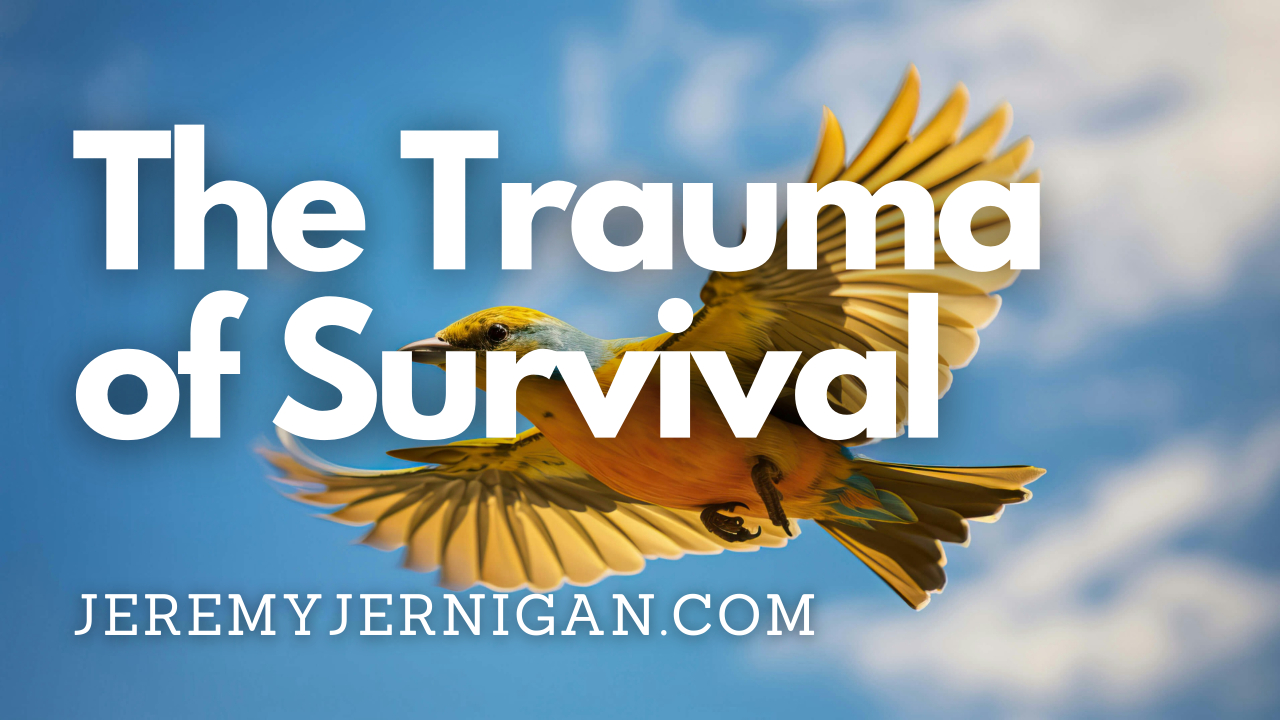
So if we woke up this morning, then we choose to endure. In addition to his phrase about survival, Andrew also offered this analogy in his article: "It's a bit like kicking birds out of their nests and scoffing at their fall. Birds fly." Some seasons of life feel like you are constantly being kicked out of your nest. And as disconcerting as that can be, it reminds you to fly. Even if you didn't feel like flying.
We don't give in to the despair or the dehumanization or the destruction or the damnable depravity we see around us. When pushed from the nest, we choose to fly.
I don't know what heaviness you carry with you today. I don't know how much of the world around you lives on your shoulders. It is often those who care and are willing to pay attention who feel the weight most acutely. The trauma of survival can be significant. But it can always be countered.
We fight by flying.
One thing I hear more than anything else from people in this community: "I thought I was the only one." You're not. The Rebuilding Faith community is a private space for people rebuilding their faith outside the walls of institutional Christianity — guided book studies, live monthly calls, weekly behind-the-scenes content, and actual conversation with people who get it. Starts at $10/month. No pressure — but the door's open: Find out more.
(Disclaimer: As an Amazon Associate, I may earn commissions from qualifying purchases from Amazon at no cost to you. Your reading can help support my writing. Thanks!)
Sign up with your email and never miss a post!
We hate SPAM. We will never sell your information, for any reason.