What the Pirates Got Right
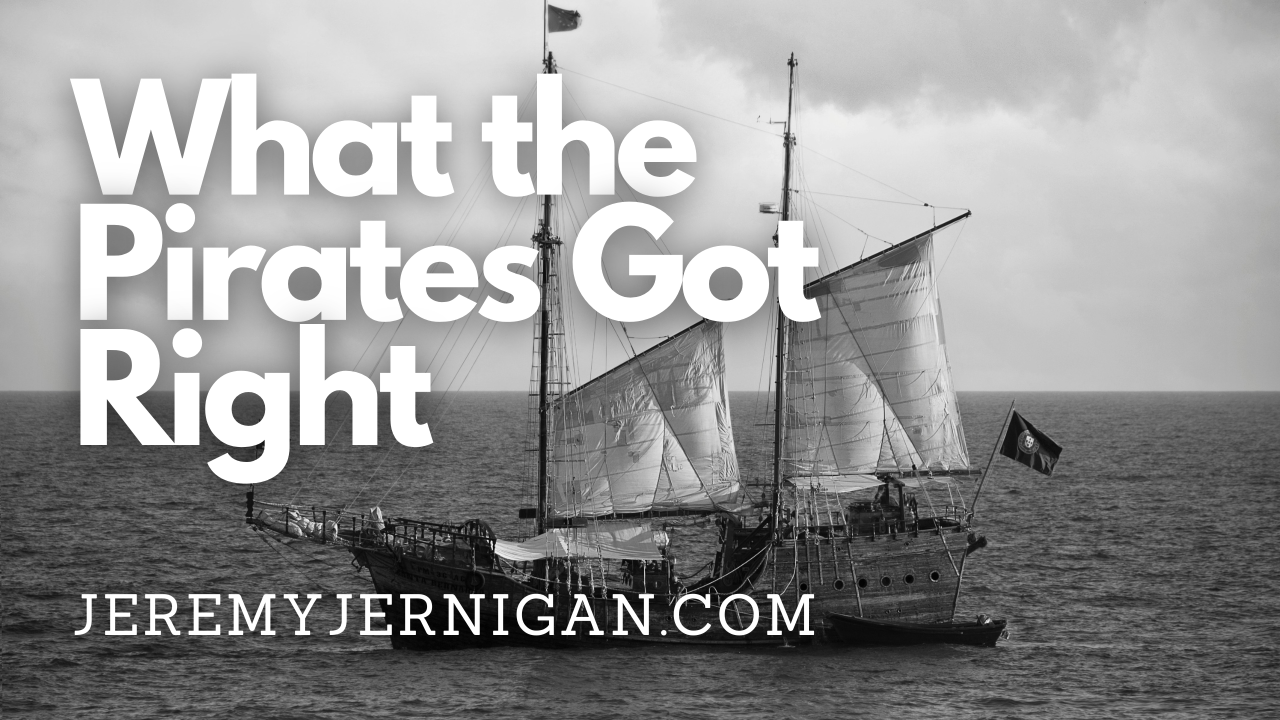
It is one in the morning, and I am the captain of a stolen ship.
The Jackdaw is mine. The Caribbean is a wall of turquoise light, a storm is rolling in from the east, and I am chasing a Spanish frigate across water that Ubisoft has rendered with what I can only describe as unreasonable beauty. Assassin's Creed Black Flag Resynced came out earlier this month, a full remake of a game I loved thirteen years ago, and I have lost an embarrassing number of evenings to it. There is a sea shanty playing. My crew is singing. I regret nothing.
None of this should come as any surprise if you've read The Edge of the Inside (or even started reading it). That's because my opening line in the book is: "I’ve always been fascinated by pirates."
I have also, in a bit of related enthusiasm, been reading David Cordingly's Under the Black Flag, which is the book you read if you would like the romance of the video game gently taken away from you. Cordingly helped organize a major exhibition on piracy at the National Maritime Museum in London, and his whole project separates the pirate we imagine from the pirate who actually existed. It is a wonderful book, but it is also a bit of a slow-motion demolition of much that makes the video game fun.
Walking the plank, for instance, is fiction. Cordingly points out that most of us assume pirates made their victims walk the plank because that is the fate Captain Hook was planning for the Lost Boys. Real pirates had no time for the ceremony. Seamen who resisted were hacked to death and thrown over the side.
The treasure is a disappointment too. You picture chests of doubloons. The typical haul, Cordingly writes, was a few bales of silk and cotton, some barrels of tobacco, an anchor cable, some spare sails, and the carpenter's tools. You risked hanging for the contents of a hardware store.
So the fantasy mostly collapses on contact with the footnotes. There is one exception. Cordingly writes that the pirate ship was unlike the Royal Navy, the merchant navy, or any other institution of the seventeenth and eighteenth centuries. Then this sentence, which I have now read about ten times:
A hundred years before the French Revolution, the pirate companies were run on lines in which liberty, equality, and brotherhood were the rule rather than the exception.
On a pirate ship the captain was elected. If the crew decided he was a coward or a fool, they could vote him out and choose someone else, and they regularly did. The crew, not the captain, decided where to sail and which ships to attack. The plunder was divided according to written articles that every man signed. The captain's share was bigger than the rest, but not by much.
Now hold that next to the ship it was running from. The Royal Navy of the same century ran on the lash. A captain's word sat somewhere above the reach of appeal, and the men beneath him lived in the conditions that drove sailors to piracy in the first place. The lawful ship, the respectable one, the one flying the flag of a Christian nation, was a floating tyranny. The criminals who fled it built something rougher and more accountable out in the open water.
Which reminds me, as most things eventually do, of something Jesus said.
His disciples were arguing about who would get the best seats in the coming kingdom, and Jesus gathered the whole group together.
But Jesus called them together and said, "You know that the rulers in this world lord it over their people, and officials flaunt their authority over those under them. But among you it will be different. Whoever wants to be a leader among you must be your servant" (Matthew 20:25-26).
You know how the rulers do it. The chain of command, the lash, the officer whose authority answers to no one below him. And then Jesus turns it over. Among you it will be different. The people who claim to follow him are supposed to be the ones who took the naval hierarchy and flipped it, so that power answers to the people it is meant to serve. A leader you could, in effect, vote out. Instead we built the flagship.
I am not about to tell you the pirates were secretly the good guys. Many of them had been privateers first, trained and armed and flagged by the very empires that later hunted them. The difference between the two was mostly paperwork. Strip the paperwork and the same men did the same things, only now without a nation calling it lawful.
In the same chapters where Cordingly documents their strange democracy, he takes care to kill the more flattering myth. The notion that pirate equality extended to the Black men aboard is, he writes, "a romantic idea, but it is not borne out by the facts." The pirates "shared the same prejudices as other white men in the Western world. They regarded black slaves as commodities to be bought and sold." The men who elected their captains also trafficked human beings and killed anyone who resisted them. It was violent in a more honest register.
So the pirate ship is not a model. It got exactly one thing right, refused to lord authority over its own crew, and got almost everything else catastrophically wrong. Both of those are true at the same time, and we can refuse to flatten either one.
This is why I opened my own book with pirates. The Edge of the Inside is a book about leaving the center, and this image would not leave me alone. The people at the edge are not better than the people at the center. The edge is simply where the pretending tends to run out. The flagship gets to fly the colors of a decent nation and call its cruelty order. The outlaw has no such cover. Whatever else you want to say about the ship under the black flag, it was not lying about what it was.
And that, in the end, is the thing the video game gets right without meaning to.
Cordingly explains that black was the color of death and red meant no quarter, no mercy, everyone dies. The flag existed to strike terror, so a merchant crew would give up without a fight. Whatever else you think of it, it was honest advertising.
Pirates did sometimes approach under borrowed colors, the flag of a friendly nation, closing the distance while looking harmless. But the encounter always ended the same way. Down came the borrowed flag, up went the real one. At the moment of contact, every ship in those waters showed its true colors. Spain's flag announced a monarchy, and a monarchy is what boarded you. England flew the empire. The black flag promised robbery and kept its promise. None of them were lying.
There is one flag in the whole story that lies. It is the one Jesus handed his disciples when he told them it would be different among them. We have flown it over ships that run exactly like the ones he was warning them about. The cross at the masthead, the admiral in the cabin, the crew with no vote.
Every ship flies a flag. The question is whether your deck would give the flag away.
If this resonated, there's more where it came from. The Rebuilding Faith community is where I do this work every week alongside people rebuilding their faith on the outside of institutional Christianity — book studies, live calls, weekly newsletter, and honest conversation. Find out more.
Photo by Margarida CSilva on Unsplash
(Disclaimer: As an Amazon Associate, I may earn commissions from qualifying purchases from Amazon at no cost to you. Your reading can help support my writing. Thanks!)
Sign up with your email and never miss a post!
We hate SPAM. We will never sell your information, for any reason.