We Grasp for Quick Certainties
Recently, I saw a video of a bird covered in ants that made me want to scroll past quickly. I don't enjoy watching something suffer, and I wasn't interested in whatever clickbait video this was. But before I moved on, the video explained that the bird wasn't being harmed.
Now I was intrigued. How on earth could this bird be covered in ants and not be harmed? It literally looked like it was being slowly devoured alive. Instead, the video explained that this behavior is known as "anting," and the bird did it for its own benefit.
If I didn't have that explanation, there is zero chance I would have come to that conclusion.
To be fair, I have a similar reaction with people too. I can watch something a person says or does and come away with a conclusion far different from what they intended. One reason this happens is that we all operate with a deep story, or underlying narrative, that connects our values to how we make sense of the world. We may not even be fully aware of our own deep stories, let alone the people around us.
Today is midterm election day, and our deep stories are clashing loudly.
Regarding birds covering themselves in ants, the prevailing explanation is that this is essentially a parasite treatment. Ants spray formic acid when they feel threatened. This acid benefits the bird because it can kill parasites on its wings or even heal fungal infections. Most birds either seem unfazed by the bites they get or fly away when they've had enough. This is the bird's deep story.
When you hear that story, it helps you make sense of a bird strategically flying onto an anthill and then intentionally angering them to get the result it wants. Without the deep story, it just looks like madness.
I recently finished Arlie Russell Hochschild's book, Strangers in Their Own Land. It was an attempt, back in 2016, by a progressive from Berkeley to better understand the "anger and mourning on the American Right," as the subtitle puts it. I chose the book because admittedly, I often struggle to understand why today's Republicans say and do much of what I see. I believe in being curious, and I try to learn, even from people I disagree with.
Hochschild spends an extended period of time with people in Louisiana bayou country as they explain their perspectives. Ten years ago marked the rise of the current administration and the Republican Party as it is today. She observed their deep story like this:
Strangers step ahead of you in line, making you anxious, resentful, and afraid. A president allies with the line cutters, making you feel distrustful, betrayed. A person ahead of you in line insults you as an ignorant redneck, making you feel humiliated and mad. Economically, culturally, demographically, politically, you are suddenly a stranger in your own land. The whole context of Louisiana—its companies, its government, its church and media—reinforces that deep story.
I don't resonate with today's Republican Party, but I can resonate with being cut in line and feeling bothered about it. That's where we find the way forward. Rather than bemoaning the fact that some people feel like they've been cut in line, we can meet them in that feeling and figure out why. Then we can see whether there's a way to make sure everyone gets a chance to reach the front of the line.
I know this might not land for either side. My progressive readers may be bothered by a sense that I'm validating a harmful perspective, and my conservative readers might be rolling their eyes at my naivete. I get it. But I believe every single person is profoundly made in the image of God, no matter how much they may anger us.
Let's return one final time to the birds and ants. While there seems to be a consensus on why birds perform this behavior, there are other theories too. Some have suggested the birds drain the ants of their sour fluid before eating them, as perhaps ants taste better without formic acid. Some have even suggested that the birds get a high from the acid and enjoy the feeling.
How would we know for sure? I guess we'd have to ask the bird.
On this election day, I hope you vote with empathy. I hope you realize your voice matters and that the laws, policies, and leaders we choose will directly impact us all, especially vulnerable people. Dr. David Gushee argues that "In view of the track record of the varied forms of government, democracy is not only the best governance option heretofore developed, but in fact one of the highest achievements of humanity."
You are entitled to your deep story. But remember that those you want to villainize also have a deep story that allows them to make sense of the world. It's easy to write people off, but that also leaves others out. I want to work to create a society where we give everyone a chance to thrive and actively work against anything standing in the way. One challenge in working together toward this is what Hochschild calls an "empathy wall."
An empathy wall is an obstacle to deep understanding of another person, one that can make us feel indifferent or even hostile to those who hold different beliefs or whose childhood is rooted in different circumstances. In a period of political tumult, we grasp for quick certainties.
Certainty feels better than doubt, but it is usually an illusion. It's also lazy. It comes from our unwillingness to do the work. As Hochschild explains, "Our polarization, and the increasing reality that we simply don't know each other, makes it too easy to settle for dislike and contempt."
We do indeed have significantly different values at times. But that can cause us to overlook our shared humanity. Meeting others we disagree with from a posture of empathy and curiosity gives us the best chance to share that humanity. Hochschild shows that empathy is the way forward.
We, on both sides, wrongly imagine that empathy with the "other" side brings an end to clearheaded analysis when, in truth, it's on the other side of that bridge that the most important analysis can begin.
Oh, and if you're interested in watching a bird practice "anting," here's a video that shows it well. It's one heck of a deep story.
One thing I hear more than anything else from people in this community: "I thought I was the only one." You're not. The online community is a private space for people rebuilding their faith outside the walls of institutional Christianity — guided book studies, live monthly calls, weekly behind-the-scenes content, and actual conversation with people who get it. $10/month. Find out more.
(Disclaimer: As an Amazon Associate, I may earn commissions from qualifying purchases from Amazon at no cost to you. Your reading can help support my writing. Thanks!)
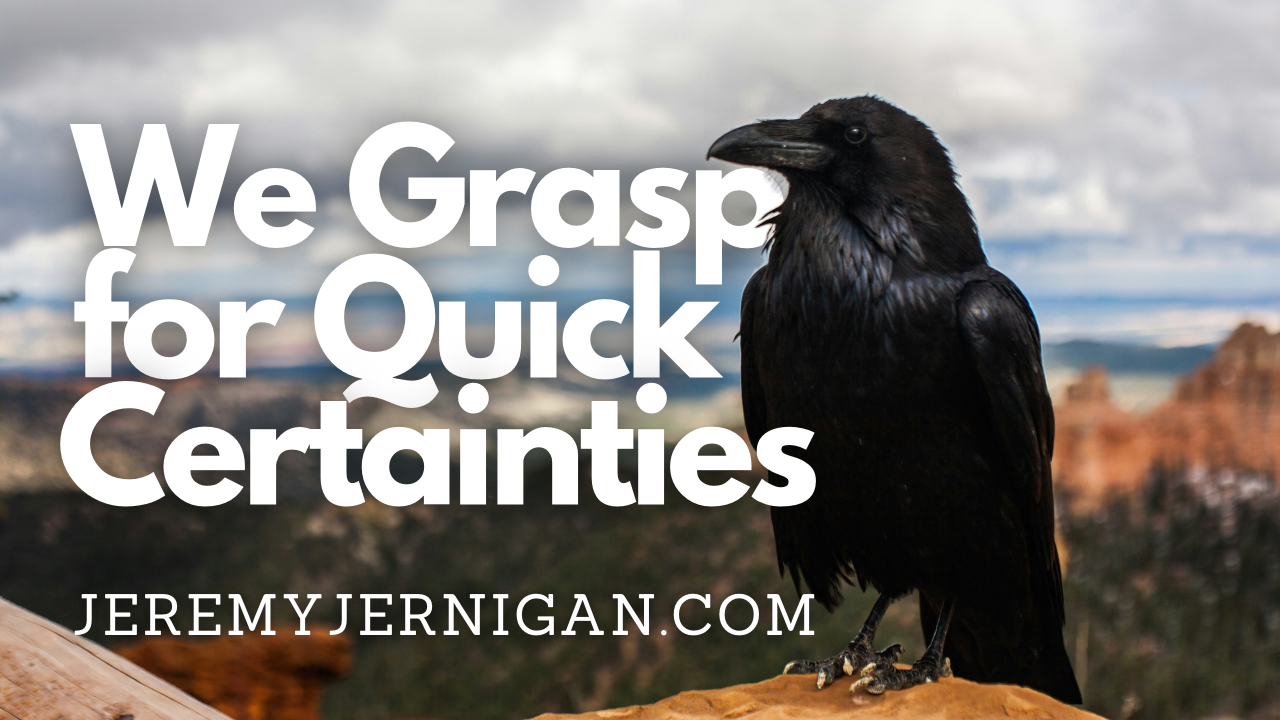
Photo by Tyler Quiring on Unsplash
Sign up with your email and never miss a post!
We hate SPAM. We will never sell your information, for any reason.