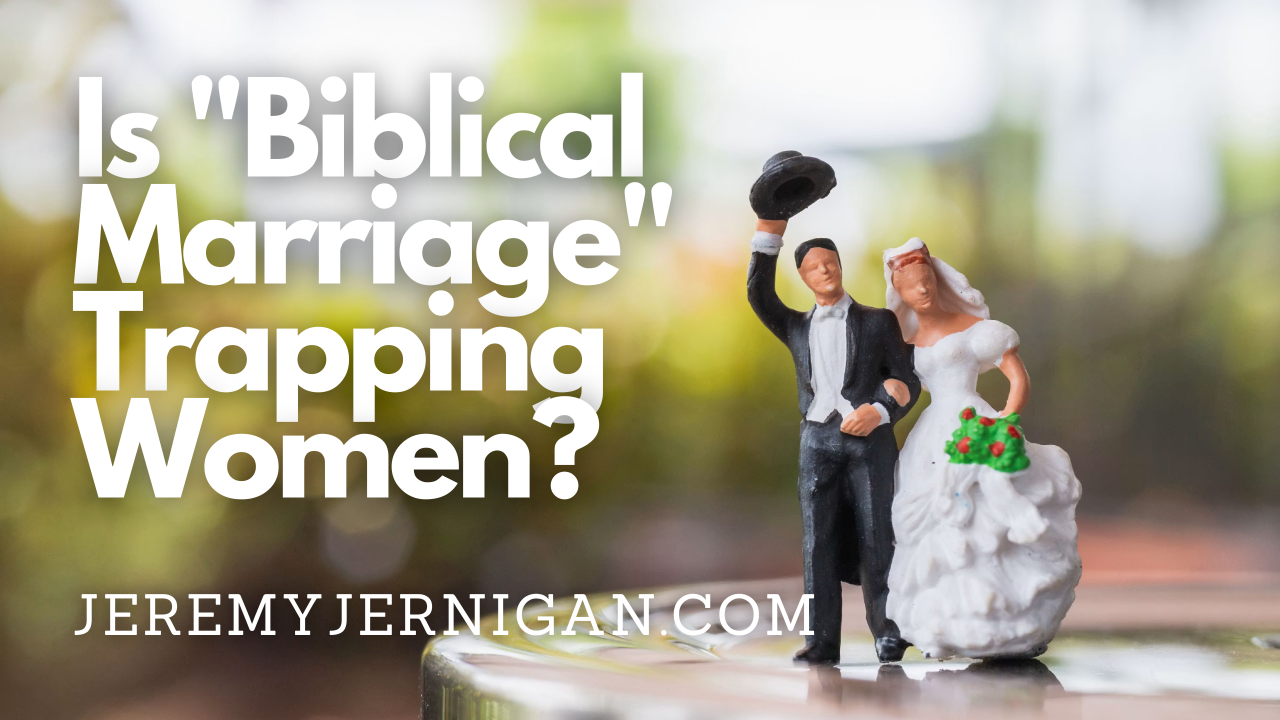
Is "Biblical Marriage" Trapping Women?
Last week, our online community had its monthly video chat. We were discussing the recent change in the gender gap for religious engagement between men and women, which I wrote about in "The Gender Gap Closed. Check the Fine Print." The trend we were discussing is that young women are less engaged in the church than before. I was curious about all the reasons for this, and I was especially interested in listening to the women in our group share. As I heard about their experiences and the experiences of their daughters, I was struck with this thought:
How many women in churches are currently in some type of abusive situation and would choose to divorce if they felt God supported it and others around them supported it?
A younger version of me would have been perplexed that I'd even ask this question.
For context, I'm not a fan of divorce. I've seen the effects of it in my own extended family, and it is incredibly hard on everyone. In fact, one of the statements that I grew up with is the idea that "A bad marriage is better than a good divorce." I didn't just agree with this idea; I taught it for years.
And yet, I'm trying to listen well. I'm trying to better understand why so many women are choosing to opt out of their religious involvement, and why young men seem eager to take their place. As I listened to the stories shared, an obvious pattern emerged. One of the things that enables women to be treated poorly is a marriage where they are not allowed to leave, for any reason. This is one factor among several, and I'm pulling on it precisely because it's the one that hides.
Admittedly, the Bible is pretty tough on this subject, even when it comes to Jesus. Jesus seems to equate most divorces to the same thing as committing adultery, even if we are not as comfortable making the same comparison today. I suspect Jesus' strictness was protecting women from disposable marriage rather than tightening a rule for its own sake, but He certainly wasn't a fan of divorce as an option.
In both examples in the Gospel of Matthew (5:31-32, 19:3-9), the conversation adds a clause about unfaithfulness. Mark and Luke record no exception at all (and John doesn't even touch this conversation). The New Testament scholar David Instone-Brewer argues we've been misreading the whole exchange. When the Pharisees ask Jesus whether a man should be allowed to divorce his wife "for just any reason" (Matthew 19:3), they're reaching for a loaded phrase.
A few decades earlier, the rabbis of the school of Hillel had invented a new form of divorce called the "any cause" divorce, which let a man dismiss his wife over something as small as a burnt meal or a wrinkle. That's the practice the Pharisees are asking about. So when Jesus answers with what Instone-Brewer calls "a resounding no," He's turning down frivolous divorce, the kind reached for on a whim, and leaving the older protections in place.
Those protections are the part that matters here. Long before Hillel, Jewish law let a spouse walk away from a marriage for neglect, and Instone-Brewer draws the sharpest line for our purposes: "Divorce for neglect included divorce for abuse, because this was extreme neglect."
As I reflect on all of this in our moment, a wooden reading of these verses gives an uncomfortable degree of cover to men who want to use them to mistreat their wives. This is nothing new. But Instone-Brewer's work cuts against that cover. The men clinging to "the Bible clearly says" are usually clinging to an English surface reading. Read the text the way its first hearers did, and it turns and protects the person being harmed. The label "Biblical" ends up attached to the shallowest reading available.
Which is why that label does less work than people think. I chuckle a little whenever someone appeals to a "Biblical marriage," since a fully Biblical marriage would include things like polygamy. When Jesus talks about divorce, our task is to understand what He was doing, especially in light of everything else we know about Him.
How does Jesus view the woman in a marriage that intentionally robs her of life? How does God view the husband who emotionally, verbally, or physically harms his wife? Especially when he does those things under the cover of his wife being unable to do anything about it?
Here's a more uncomfortable question for us right now: Is the Church's strongly negative reaction to divorce enabling some men to abuse their wives?
I'm not trying to convince you that divorce is good. I'm trying to remind you that abusing other people is really bad, especially when it's done in the name of Jesus. In fact, as I follow the Way of Jesus, I'm convinced you could reduce the essence of all He taught and modeled for us as a way of living that brings life to the people around you. The Gospel is fundamentally life-giving to others.
So when we discover a group of people using the umbrella of Christianity to allow them to rob life from their spouse, we should be willing to say something about it. One of the reasons we are seeing the religious gender gap change is that women have more autonomy to make their own choices. Which takes us back to my original thought.
Would a woman suffering in an unhealthy marriage be more empowered to do something about it if she wasn't afraid that God would be disappointed in her? Would she be more empowered to do something about it if she wasn't afraid that her friends and family would be disappointed in her?
Or, if you have the imagination for it, would a woman be more likely to choose to get out of an abusive marriage if she believed that God and her community supported her refusing to be abused by her husband?
I'm not saying any of this should be flippantly discussed or entertained. I believe that marriage is beautiful and difficult. Two becoming one is an incredibly painful process that has the potential to create unbelievable good. But this same mechanism can also be used for unspeakable harm, and those of us who love marriage and who follow Jesus must not look away from this uncomfortable truth.
If you are reading this and you know your marriage is being used to rob you of life, I encourage you to do something about it. The Jesus I met isn't going to hold a grudge against you for being willing to stand up to the abuse, even if that means you might eventually need to walk away from it. There are many Christians who will walk with you down this road and support you in what's ahead. This isn't something to do alone or abruptly. Leaving is often the most dangerous moment, so it's worth a plan and people who know.
If you are reading this and someone you know comes to mind, I encourage you to reach out to them. Show them that God's desire for their life is not to be in a relationship of abuse hiding under the umbrella of Christianity.
As Jesus prepared His disciples to navigate life without Him being physically present with them, He told them about the role the Holy Spirit would play in their future journey. "When the Spirit of truth comes, he will guide you into all truth" (John 16:13 NLT). The challenge for them and for us is to join the Spirit in moving forward in the Way of Jesus, even when it leads us into some unfamiliar territory (as the Spirit does all throughout the book of Acts).
One thing I hear more than anything else from people in this community: "I thought I was the only one." You're not. The online community is a private space for people rebuilding their faith outside the walls of institutional Christianity — guided book studies, live monthly calls, weekly behind-the-scenes content, and actual conversation with people who get it. $10/month. Find out more.
Photo by Amna Tahir on Unsplash
Sign up with your email and never miss a post!
We hate SPAM. We will never sell your information, for any reason.